
How I Recover Mentally After an Investment Loss
There is a side of investing that rarely gets discussed openly, especially among people who are still building their financial lives and trying to be responsible at the same time. It is not about how to analyze a company, when to enter the market, or how to diversify properly. It is about what happens after…
There is a side of investing that rarely gets discussed openly, especially among people who are still building their financial lives and trying to be responsible at the same time.
It is not about how to analyze a company, when to enter the market, or how to diversify properly.
It is about what happens after you lose money, when the numbers on the screen start to feel personal and the confidence you built quietly over time begins to shake.
I learned this lesson through a very real experience that stayed with me far longer than I expected because of what it revealed about my relationship with risk, control, and self-trust.
The Investment I Felt Confident About

Several years ago, after already having some experience with investing, I decided to put a meaningful amount of money into a single stock that I genuinely believed in
I had followed the company for months, read through its financial reports, and believed its long-term direction made sense in the context of the market at that time.
The amount I invested was $8,000, which for me was significant. That money represented discipline, patience, and many months of choosing not to spend on other things.
It was part of what I consider my future money, not something I would ever rely on for daily stability, and because of that, I felt I was being responsible rather than reckless.
For the first few months, nothing unusual happened. The stock moved slowly, sometimes up, sometimes down, in the way investments usually do.
I checked occasionally, felt calm, and continued living my life without much emotional attachment to that position.
Watching the Loss Grow Over Time
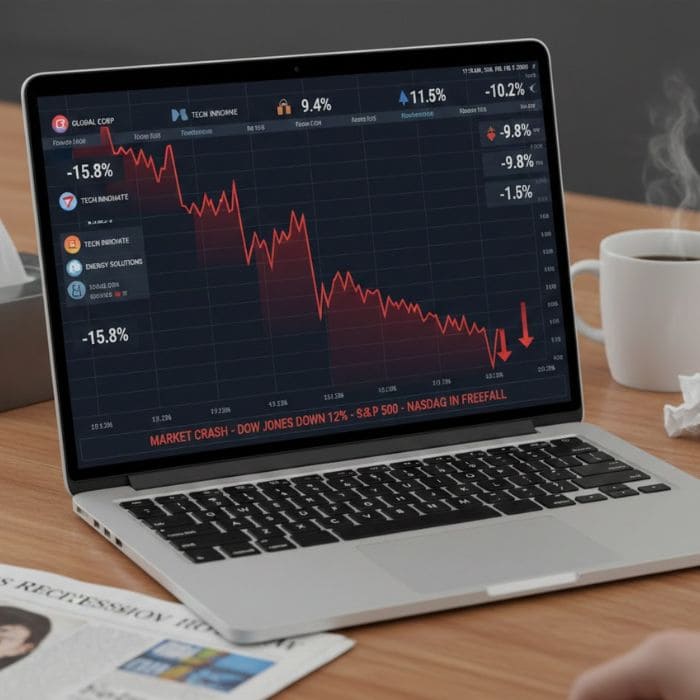
The decline came slowly, in a way that made it easy to ignore at first. A few percentage points disappeared, then a few more the following month.
I told myself this was normal, because volatility is part of investing, and at that stage, I still believed fully in the company’s long-term story.
Gradually, however, the numbers became harder to dismiss. My $8,000 position dropped to around $6,500, then continued down to $5,800, and eventually reached a point where it hovered close to $5,200.
On paper, I was facing a loss of almost $2,800, and seeing that number repeatedly began to affect me in ways I had not anticipated.
What surprised me most was not the financial loss itself, but the emotional response that followed.
Every time I opened my investment account, I felt a subtle tension in my chest. Some days I avoided looking altogether, while other days I checked far too often, as if staring at the numbers could somehow change the outcome.
I replayed my decision endlessly, questioning whether I had been too confident, whether I had missed obvious warning signs, or whether I simply was not as capable as I thought.
The loss began to feel like a judgment on my intelligence rather than a normal part of investing.
When the Loss Became Mental, Not Financial

At some point, I realized that my biggest struggle was no longer about money. I was less afraid of losing more money than I was afraid of being wrong.
To cope, I consumed more information. I read analysis, watched market commentary, and searched for reassurance that the stock would eventually recover.
Instead of helping, this only increased my anxiety, because every opinion contradicted the next and no one truly knew what would happen.
That was when I understood something important. I was reacting emotionally, and as long as I stayed in that state, no decision I made would be a good one.
Creating Distance on Purpose
I set a strict rule for myself that I would stop checking that investment daily and would only review it once a month, on a specific date – the 15th.
This was not about denial or avoidance, but about giving my nervous system room to calm down so I could regain perspective.
Once I stopped monitoring the loss constantly, the emotional intensity slowly decreased.
The investment stopped feeling like an immediate threat and started to return to what it actually was, which was a long-term decision unfolding in an uncertain environment.
Separating the Loss From My Self-Worth
As the emotional noise faded, I began working through a much harder realization. Losing money did not mean I was bad at managing finances, and it did not invalidate the care I had taken up to that point.
I reminded myself repeatedly that investing is not about certainty. It is about making the best possible decision with incomplete information, and sometimes those decisions do not work out.
Once I stopped tying the outcome to my self-worth, I could finally evaluate the situation objectively.
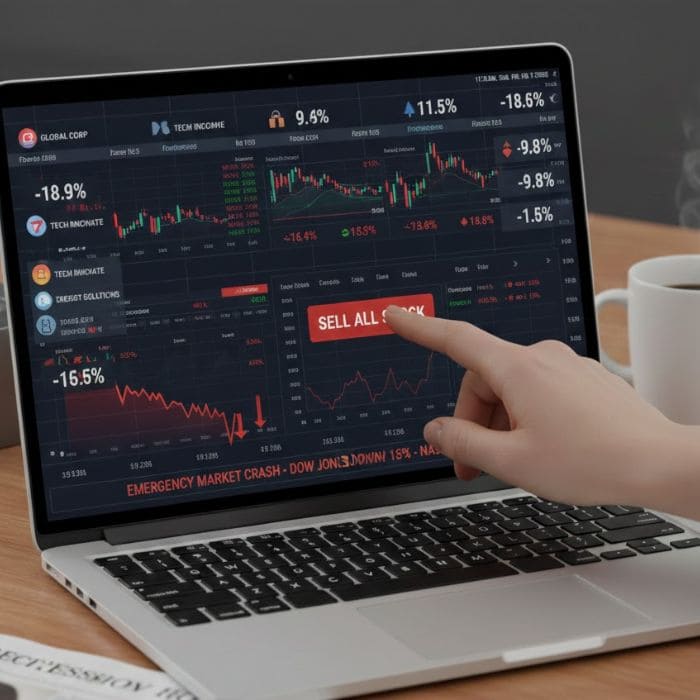
After several months of distance and reflection, I reached a point where my confidence in the company’s long-term direction had genuinely changed.
This was not fear talking, but clarity. Holding onto the stock simply to avoid admitting a loss would have been an emotional decision rather than a strategic one.
I sold my position when it was worth about $5,400, locking in a loss of roughly $2,600.
The moment I completed the sale, I expected regret or shame. Instead, I felt relief.
Rebuilding Trust After the Loss
I did not try to recover the loss quickly, because chasing losses only creates new ones. Instead, I focused on rebuilding trust in my process.
I reviewed what had gone wrong calmly and noticed that I had concentrated too much money in a single position, even though it technically fit within my investment plan.
That insight helped me adjust my approach moving forward, by diversifying more intentionally and sizing positions more conservatively.
That loss changed how I invest, but more importantly, it changed how I relate to uncertainty.
I now ask myself not only whether an investment makes sense on paper, but whether I am emotionally prepared to see it fluctuate without panic or self-doubt.
That question has saved me far more stress than any technical strategy ever could.
Final Reflection
Recovering mentally after an investment loss is not about pretending it didn’t hurt or rushing to move on.
That $2,600 loss did not ruin my financial life. It strengthened it. It taught me humility, emotional discipline, and respect for uncertainty, lessons that continue to shape how I make decisions today.
In the end, the money was gone, but the understanding I gained from losing are calmer and more confident choices.
Refer to: Should Young People Invest in Stocks?