I Believe Good Financial Management Starts With Sustainable Living
For a long time, I thought financial management and sustainable living were two separate ideas. One belonged to spreadsheets, budgets, and long-term planning. The other belonged to documentaries, campaigns, and conservations that felt important but distant from daily life. However, I changed that belief. When you are responsible for everything in your home, every bill,…
For a long time, I thought financial management and sustainable living were two separate ideas.
One belonged to spreadsheets, budgets, and long-term planning. The other belonged to documentaries, campaigns, and conservations that felt important but distant from daily life.
However, I changed that belief. When you are responsible for everything in your home, every bill, every purchase, every habit becomes visible.
Plus, the trash you produce has no one else to sort. The choices you make, even the small ones, show up in very concrete ways.
That is when I started to believe something very simple: a good life today requires both solid financial management and sustainable living.
Reducing my carbon footprint was not something I did to feel virtuous. It started as a way to reduce waste, reduce costs, and reduce unnecessary stress.
Gradually, it became one of my core principles of living alone. Here are the ways I actually do it.
1. Classifying Trash Became a Daily Financial Habit
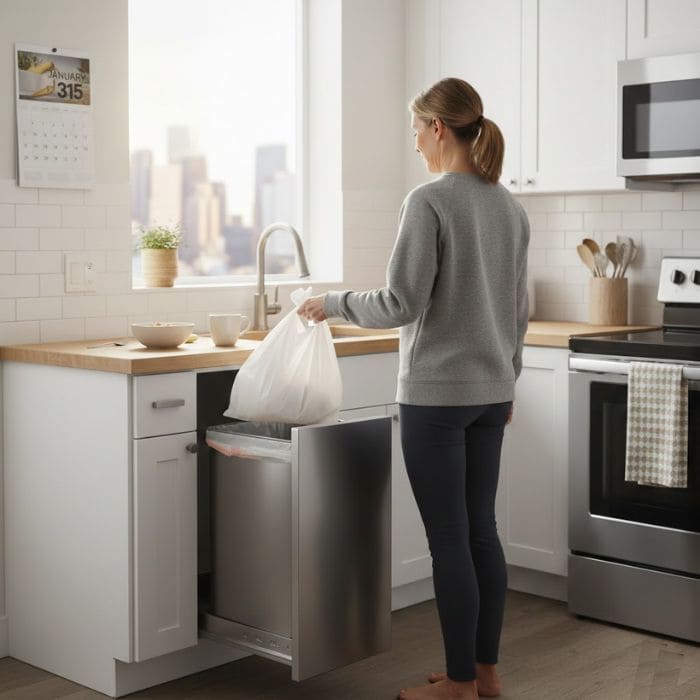
Yes, trash. When I first moved into my own flat, my kitchen trash situation was simple and careless.
At the end of the day, I felt slightly uncomfortable about it, but not enough to change. Then one evening, while taking the trash out after a long workday, I realized how much waste I was producing without thinking.
That was the moment I changed my kitchen setup. Now, in my kitchen, I have three clearly separated trash containers:
- One for organic waste
- One for recyclables like paper, plastic, and glass
- One for non-recyclable waste
At first, it felt annoying as I had to think before throwing something away. But within a few weeks, it became automatic.
My Daily Task
Every day, after dinner or before bed, I quickly check the bins.
Organic waste goes out frequently to avoid smell. Recyclables are flattened, cleaned, and stored neatly. This small daily task takes less than five minutes, but it changed how I shop and cook.
I also became more aware of packaging. I stopped buying products with excessive plastic and started choosing loose produce when possible.
My Weekly Task
Once a week, usually on Sunday morning, I take all sorted trash out. Then I clean the bins lightly and reset the system.
This habit not only reduced my carbon footprint, but also reduced impulse buying, unnecessary packaging, and wasted food.
2. Conserving Energy Is Not About Earth Day, It’s About Reality

Let me ask you something honestly, have you ever looked at your electricity bill and thought, How did it get this high?
I have. Three years ago, I traveled for one week. I packed quickly, locked the door, and left without thinking twice.
When I came back, everything felt normal until the electricity bill arrived. “Oh my God, it was noticeably higher than usual.”
After checking everything, I realized I forgot to turn off a lamp and a device on standby. Since then, I turn off the lights when leaving a room.
I unplug devices I don’t need overnight. I use energy-efficient bulbs, and I adjust heating and cooling thoughtfully.
Conserving energy at home reduced my bills and gave me a sense of control. It made my financial management feel grounded in everyday action.
3. Public Transport Is Part of My Daily Financial Strategy
I live close to work, and my daily commute is simple. I use public transport most days, and sometimes I walk.
Using public transport saves money, yes. But more than that, it removes a layer of stress from daily life.
I don’t have to worry about traffic anxiety, parking costs, and fuel worries. My commute becomes a transition time instead of a battle.
During those rides, I read, think, or simply sit quietly. It gives me space to reset between work and personal life.
Financially, the savings add up over time. Environmentally, the impact is smaller. And of course, mentally, it feels lighter.
4. Choosing Fabric Bags Over Fashion Statements

I know many women who love fashion and prioritize handbags from luxury brands. I understand the appeal.
Fashion can be expressive, empowering, and joyful. But for me, my relationship with consumption has changed.
I carry fabric bags which are reusable, simple, sometimes plain. I keep them folded in my bag, in my car, by the door.
Honestly, I don’t want my identity to depend on constant consumption. I want my financial resources to go toward stability, experiences, and long-term security.
This doesn’t mean I never buy nice things, it means I buy fewer things, with more intention. Fabric bags became a symbol of that choice.
A Quiet Conclusion
I bet that none of these habits make headlines and none of them are extreme. But together, they shape a life that feels balanced.
Good financial management is not just about income, saving rates, or investment strategies. It is about how you live every day.
Living alone taught me that sustainability and finance are deeply connected. When you respect resources, you respect yourself. When you reduce waste, you reduce stress. When you live intentionally, your money works with you, not against you.